
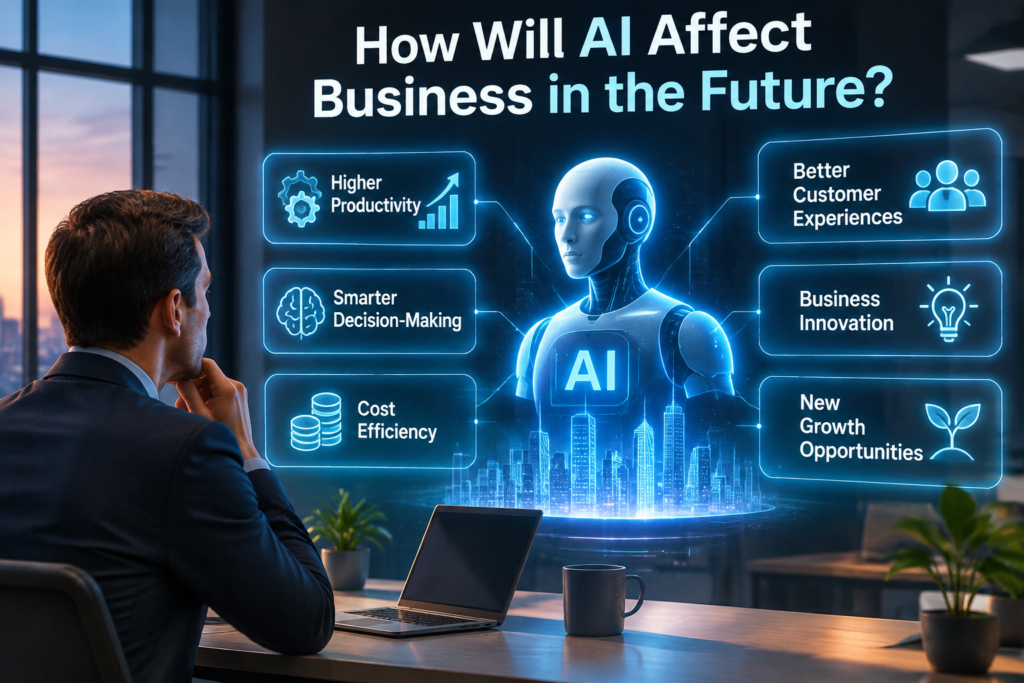
Artificial Intelligence (AI) is rapidly changing the business world, and its influence is expected to become even greater in the coming years. From small businesses to large corporations, organizations across the United States are exploring AI technologies to improve productivity, automate operations, understand customers, and create new growth opportunities. As technology continues to advance, AI will play an increasingly important role in shaping business strategies and workplace operations.
But how will ai affect business in the future? Will AI transform traditional jobs, change customer expectations, and create entirely new industries? The answer is likely yes. Businesses are already experiencing significant changes through machine learning, automation, generative AI, and intelligent data analysis.
In this article, NewTechEveryDay explores the biggest AI trends and predictions that could shape the future of businesses in the USA, including opportunities, challenges, and the skills companies will need to remain competitive.
1. AI Will Automate More Business Operations
One of the biggest changes expected in the future is the expansion of business automation. AI-powered systems will increasingly handle repetitive administrative tasks, organize business information, process documents, and support everyday operations.
For example, businesses may use intelligent software to manage invoices, schedule appointments, answer customer questions, and monitor internal workflows. This will allow employees to spend more time on creative projects, strategic planning, and customer relationships.
The growth of intelligent automation will also help companies reduce manual errors and improve operational efficiency.
Small businesses could benefit significantly because affordable AI platforms will make advanced automation accessible without requiring large technology departments.
2. AI Will Transform Customer Service
Customer expectations are changing, and people increasingly want quick, convenient, and personalized support. In the future, AI will help businesses provide customer service across websites, mobile applications, social media, and messaging platforms.
Advanced AI assistants will understand customer questions, remember relevant conversation context where appropriate, and provide more useful responses.
Businesses will also use AI-powered chatbots to handle common inquiries, track orders, explain services, and direct complex requests to human representatives.
Rather than completely removing human customer support, many organizations will adopt a combination of AI assistance and human expertise.
This approach can help companies provide faster support while maintaining meaningful customer relationships.
3. Generative AI Will Change Content Creation and Marketing
Generative AI is expected to become an important part of future marketing strategies. Businesses already use AI tools to develop content ideas, create advertising drafts, analyze audiences, and prepare marketing materials.
Future systems may provide more advanced assistance with campaign planning, video production, product descriptions, and personalized advertisements.
Through generative AI applications, marketing teams could produce different versions of content for specific audiences while reducing repetitive creative work.
However, human creativity and editorial supervision will remain important. Businesses must ensure that published content is accurate, original, useful, and consistent with their brand identity.
Companies that combine AI efficiency with human creativity will have opportunities to build stronger marketing strategies.
4. AI Will Improve Business Decision-Making
In the future, businesses will increasingly depend on AI to understand large amounts of information and identify patterns that might otherwise be difficult to recognize.
For example, retailers may use AI to predict product demand, financial organizations may evaluate market risks, and manufacturers may identify production problems before they affect operations.
The development of predictive analytics will allow companies to make better-informed decisions based on historical information and changing business conditions.
AI systems may also help business leaders compare different strategies and estimate potential outcomes.
Nevertheless, important decisions should involve human judgment, especially when financial, legal, or ethical consequences are involved.
5. AI Will Create New Jobs and Change Existing Careers
AI will influence the future workplace by changing how employees perform their responsibilities. Some repetitive activities may become automated, while new opportunities will emerge in AI development, data management, cybersecurity, technology consulting, and AI governance.
Employees will increasingly need digital knowledge and the ability to work alongside intelligent software.
Businesses will invest more in AI workforce training to help employees understand new technologies and develop relevant professional skills.
Rather than focusing only on technical positions, companies will also need workers who can combine industry experience with problem-solving, communication, and critical thinking.
For US businesses, preparing employees for these changes will be an important part of long-term growth.
6. Small Businesses Will Gain Access to Advanced Technology
AI technology is becoming more accessible, creating opportunities for small businesses and startups.
In the future, smaller companies may use AI platforms to analyze customer behavior, manage inventory, create marketing campaigns, and automate administrative activities without building their own expensive technology systems.
Affordable cloud-based AI solutions will make it easier for entrepreneurs to access advanced computing capabilities through online platforms.
For example, a small online store could use AI to recommend products, forecast demand, and respond to customer questions.
This could help smaller organizations compete with larger companies by improving efficiency and delivering better customer experiences.
7. AI Will Transform Healthcare and Financial Services
Healthcare and financial services are expected to experience further AI-driven innovation.
In healthcare, AI could help medical professionals analyze medical images, organize patient information, support research, and improve administrative processes. These systems may contribute to more efficient healthcare services when used with appropriate professional oversight.
In financial services, AI will continue supporting fraud detection, transaction monitoring, customer assistance, and financial risk analysis.
The development of machine learning algorithms will make it possible to identify complex patterns in large datasets and support more sophisticated analysis.
However, both industries must maintain strong privacy protections, security standards, and human oversight.
8. AI Will Make Supply Chains More Efficient
Supply chain management is another area where AI is expected to create significant changes.
Businesses depend on suppliers, warehouses, transportation networks, and delivery services. Disruptions in any part of this process can increase costs and delay customer orders.
Future AI systems will help companies monitor supply chain information, forecast demand, evaluate inventory levels, and identify potential disruptions.
With AI supply chain optimization, organizations can improve planning and make their logistics operations more responsive.
US businesses operating across multiple states may particularly benefit from intelligent forecasting and improved inventory management.
9. AI Will Strengthen Business Security and Fraud Detection
As businesses become increasingly digital, cybersecurity will remain a major priority.
Future AI systems will help organizations monitor networks, identify unusual activities, analyze potential security threats, and support faster incident responses.
AI cybersecurity solutions may become an important part of protecting business information, customer records, and digital infrastructure.
Financial institutions and online retailers may also use intelligent fraud detection systems to identify suspicious transactions.
However, AI itself can introduce security risks if systems are poorly designed or inadequately protected. Businesses will need strong cybersecurity policies and regular system evaluations.
10. Responsible AI Will Become a Business Priority
Although AI offers major opportunities, its future adoption will require responsible implementation.
Businesses must consider data privacy, transparency, fairness, security, and the accuracy of AI-generated information.
Organizations will increasingly need clear policies explaining how employees can use AI tools and how sensitive information should be handled.
The development of responsible AI governance will help companies establish guidelines for using AI safely and ethically.
In the United States, businesses should also pay attention to applicable federal and state requirements when deploying AI technologies.
Companies that prioritize responsible innovation can build trust with customers, employees, and business partners.
11. AI Will Increase Competition Across Industries
As AI technology becomes more widely available, competition between businesses may become stronger.
Companies will be able to use intelligent tools to improve customer experiences, develop products, analyze competitors, and respond to changing market conditions.
Businesses that adopt useful technologies early may gain operational advantages. However, simply purchasing AI software will not guarantee success.
Organizations will need clear business objectives, suitable data, employee training, and effective implementation strategies.
The future will likely favor businesses that use AI to solve real problems rather than adopting technology simply because it is popular.
Conclusion
Artificial Intelligence will play an increasingly important role in the future of business. From automation and customer service to healthcare, finance, marketing, and supply chain management, AI will create new opportunities for organizations across the United States.
Understanding how will ai affect business in the future will help entrepreneurs, business owners, and professionals prepare for upcoming changes. Companies that invest in useful AI technologies, develop employee skills, protect customer information, and maintain human oversight will be better positioned to adapt.
At NewTechEveryDay, we believe the future of business will not simply be about replacing traditional processes with intelligent machines. It will be about combining artificial intelligence with human creativity, experience, and strategic thinking.
Businesses that embrace this combination can build more efficient operations, improve customer experiences, and discover new opportunities in an increasingly competitive digital economy.
Frequently Asked Questions (FAQs)
1. How will AI affect business in the future?
AI will transform business operations through automation, predictive analytics, personalized customer service, improved cybersecurity, and smarter decision-making. It will also create new career opportunities and change existing workplace responsibilities.
2. Which businesses will benefit most from AI in the future?
Healthcare, finance, retail, manufacturing, transportation, education, and marketing businesses are expected to benefit significantly. However, companies of almost every size and industry can use AI to improve productivity and customer experiences.
3. Will AI replace human workers in the future?
AI may automate certain repetitive tasks, but it will also create new job opportunities and change existing roles. Human creativity, communication, leadership, critical thinking, and professional judgment will remain valuable.
4. How can small businesses prepare for the future of AI?
Small businesses can start by adopting affordable AI tools for customer service, marketing, scheduling, and data analysis. They should also train employees, protect customer information, and introduce AI gradually according to their business needs.