
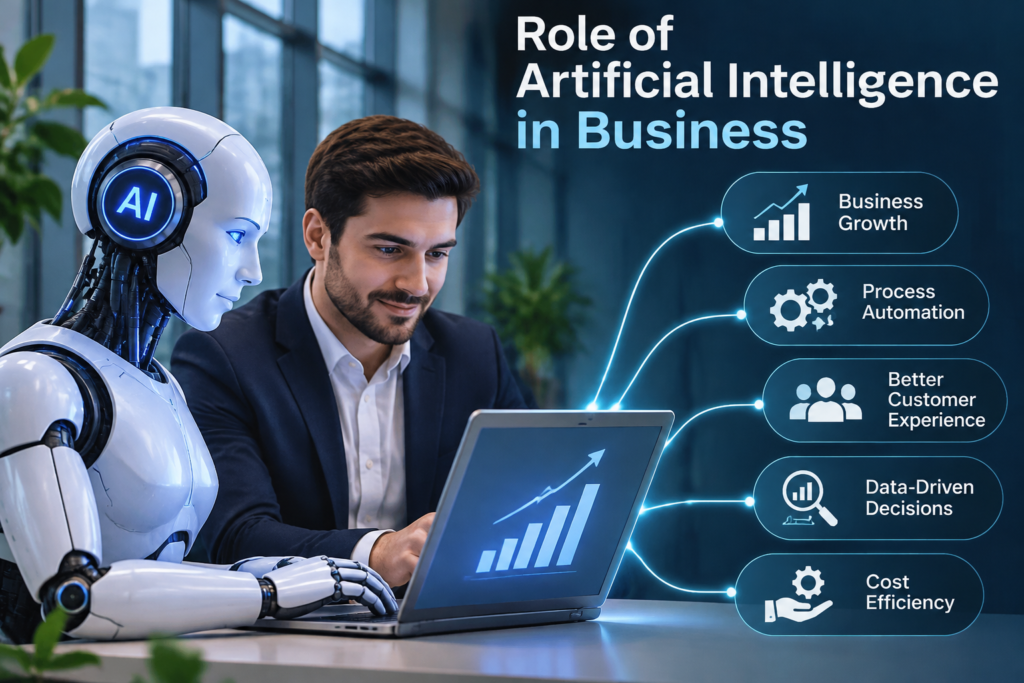
Artificial Intelligence (AI) has become one of the most important technologies transforming modern businesses. From small startups to large corporations, companies across the United States are adopting AI-powered solutions to improve productivity, automate everyday tasks, understand customer behavior, and make better business decisions. AI is no longer just an emerging technology; it is becoming an essential part of business growth and digital transformation.
The role of artificial intelligence in business goes beyond simple automation. It includes improving customer experiences, analyzing large amounts of data, strengthening cybersecurity, optimizing supply chains, and helping organizations develop innovative products and services.
Businesses in industries such as healthcare, finance, retail, manufacturing, education, and transportation are already discovering practical ways to use AI. In this article, NewTechEveryDay explores the major applications of artificial intelligence in business, real-world examples, key benefits, and how companies can use this technology to remain competitive.
1. AI in Business Automation
One of the most common applications of artificial intelligence is business automation. Companies handle numerous repetitive activities, including data entry, document processing, appointment scheduling, invoice management, and customer inquiries.
AI-powered software can automate many of these activities, allowing employees to focus on more important responsibilities.
For example, an American accounting firm can use AI tools to organize financial documents, extract information from invoices, and identify missing records. Similarly, an online retailer can automate order confirmations and basic customer support.
Business process automation helps organizations save time, reduce manual errors, and improve operational efficiency.
2. AI in Customer Service and Support
Customer service plays an important role in business success. Customers expect quick answers, convenient communication, and personalized assistance.
Businesses are using AI chatbots and virtual assistants to provide support through websites, mobile applications, and social media platforms.
These tools can answer frequently asked questions, explain product features, track orders, and direct complicated inquiries to human representatives.
For example, an online shopping company can use an AI chatbot to help customers find products, check delivery information, and understand return policies.
AI-powered customer service allows businesses to provide faster assistance while reducing the workload on support teams.
3. AI in Marketing and Advertising
Marketing is another area where artificial intelligence is creating significant opportunities. Businesses use AI to analyze customer interests, understand purchasing patterns, develop marketing strategies, and improve advertising performance.
AI tools can examine customer engagement data and help marketers identify which campaigns are generating better results.
For example, an American e-commerce company can analyze browsing behavior and purchase history to recommend relevant products to individual shoppers.
AI can also assist with content planning, advertising drafts, audience segmentation, and campaign optimization.
Through AI-driven marketing, companies can create more relevant campaigns, improve customer engagement, and use advertising budgets more effectively.
4. AI in Data Analysis and Business Decision-Making
Modern businesses generate enormous amounts of information through sales, transactions, customer interactions, and operational activities.
Analyzing this information manually can be time-consuming. AI helps companies process large datasets, recognize patterns, and identify useful business insights.
For example, a retail company can examine historical sales information to estimate future product demand. A financial organization can analyze transaction patterns to identify unusual activities.
Predictive analytics enables businesses to make informed decisions using historical information and estimated future trends.
This is an important example of the role of artificial intelligence in business, because better information can help companies improve planning and respond to market changes.
5. AI in Healthcare Businesses
Healthcare organizations are using AI to improve administrative processes, support medical research, and assist healthcare professionals.
AI applications can help analyze medical images, organize patient records, identify patterns in medical information, and manage appointment scheduling.
For example, a hospital may use AI-powered administrative software to organize patient appointments and reduce scheduling delays.
AI systems can also assist researchers in examining complex medical datasets.
However, healthcare organizations must maintain patient privacy and ensure that qualified medical professionals remain responsible for clinical decisions.
6. AI in Banking and Financial Services
Financial institutions are adopting artificial intelligence to improve security, identify suspicious transactions, and provide better customer services.
AI-powered systems can analyze transaction patterns and flag activities that may indicate fraud.
Banks also use virtual assistants to answer customer questions, provide account-related information, and guide users through routine services.
For example, a US financial institution may use AI to monitor transactions and identify unusual spending patterns that require further investigation.
Fraud detection systems help financial organizations strengthen security and respond to potential threats more efficiently.
7. AI in Manufacturing and Production
Manufacturing companies are using artificial intelligence to improve production quality, monitor equipment, and reduce operational interruptions.
AI-powered machines and sensors can monitor production processes and identify unusual equipment behavior.
For example, an automobile manufacturer can use intelligent monitoring systems to identify machinery that may require maintenance before a breakdown occurs.
This approach is known as predictive maintenance.
Additionally, industrial robotics can support repetitive manufacturing activities, improve consistency, and help employees complete production tasks more efficiently.
8. AI in Retail and E-Commerce
Retail and e-commerce businesses use artificial intelligence to improve shopping experiences and manage daily operations.
AI recommendation systems analyze customer preferences and suggest products based on browsing behavior and previous purchases.
For example, an online clothing store can recommend products based on a customer’s preferred styles, sizes, and shopping history.
Retail companies also use AI to forecast demand, manage inventory, and identify purchasing trends.
Personalized product recommendations help businesses deliver more relevant shopping experiences and encourage customer engagement.
9. AI in Human Resource Management
Human resource departments handle recruitment, employee records, performance management, and workplace administration.
AI tools can help HR teams organize applications, manage employee information, schedule interviews, and answer routine workplace questions.
For example, a company receiving hundreds of job applications may use AI to organize applications according to relevant qualifications.
However, hiring decisions should involve human evaluation to reduce potential bias and ensure fair treatment.
AI-powered recruitment can support administrative efficiency, but organizations should regularly evaluate automated systems for accuracy and fairness.
10. AI in Supply Chain and Logistics
Supply chain management involves coordinating suppliers, inventory, warehouses, transportation, and product deliveries.
AI can help businesses analyze demand patterns, forecast inventory requirements, and identify potential delivery disruptions.
For example, a US logistics company can use AI to evaluate traffic information and delivery schedules when planning transportation routes.
Supply chain optimization allows organizations to improve planning, manage resources, and reduce unnecessary delays.
These applications are especially useful for companies operating across multiple locations and states.
Real-World Examples of Artificial Intelligence in Business
Several well-known companies demonstrate how artificial intelligence can support business operations.
- Amazon: Uses AI technologies for product recommendations, logistics planning, demand forecasting, and customer experiences.
- Walmart: Uses AI and data analytics to support inventory management, demand forecasting, and retail operations.
- Netflix: Uses recommendation technology to suggest entertainment based on viewing behavior and preferences.
- JPMorgan Chase: Uses AI technologies in areas such as fraud detection, financial analysis, and operational processes.
- Google: Applies AI across search, advertising, cloud services, and productivity tools.
These examples demonstrate that AI is not limited to one industry. Businesses can apply it in different ways depending on their goals, customers, and operational requirements.
Key Benefits of Artificial Intelligence in Business
The adoption of AI offers several advantages for businesses across the United States.
- Higher productivity: Automates repetitive tasks and helps employees work more efficiently.
- Cost reduction: Improves resource allocation and reduces unnecessary manual work.
- Better customer experiences: Supports personalized recommendations and faster customer assistance.
- Improved decision-making: Helps companies analyze data and identify important patterns.
- Enhanced security: Supports fraud detection and cybersecurity monitoring.
- Business innovation: Helps organizations develop new services, products, and operating strategies.
Despite these advantages, businesses must consider implementation costs, data privacy, cybersecurity, employee training, and the accuracy of AI-generated information.
Challenges of Using Artificial Intelligence in Business
AI adoption also comes with challenges that companies should understand before implementing new systems.
First, some AI technologies require significant investment in software, infrastructure, and technical expertise.
Second, businesses must protect sensitive customer and employee information. Poor data management can create privacy and security risks.
Third, automated systems can produce inaccurate or biased results. Human supervision is necessary, particularly when AI influences important financial, employment, or customer-related decisions.
Companies should begin with clearly defined business goals, choose suitable AI tools, train employees, and regularly evaluate system performance.
Conclusion
Artificial intelligence is changing how businesses operate, communicate with customers, manage information, and compete in modern markets. From customer service and marketing to healthcare, finance, manufacturing, and logistics, AI offers practical applications across nearly every major industry.
Understanding the role of artificial intelligence in business is important for entrepreneurs, business owners, managers, and professionals who want to prepare for the future of technology.
Businesses that adopt AI strategically can improve efficiency, reduce repetitive workloads, strengthen customer relationships, and discover new growth opportunities.
As highlighted by NewTechEveryDay, successful AI adoption is not simply about replacing traditional processes with technology. It is about combining intelligent systems with human creativity, professional knowledge, and responsible decision-making.
Frequently Asked Questions (FAQs)
1. What is the role of artificial intelligence in business?
Artificial intelligence helps businesses automate tasks, analyze information, improve customer service, detect fraud, manage operations, and make better-informed decisions. It supports business productivity and innovation across different industries.
2. What are the most common applications of AI in business?
Common applications include customer service chatbots, marketing automation, predictive analytics, fraud detection, inventory management, recruitment assistance, business automation, and personalized product recommendations.
3. Can small businesses use artificial intelligence?
Yes. Small businesses can use affordable AI tools for content creation, customer support, appointment scheduling, email marketing, sales analysis, and administrative automation. Many platforms offer subscription plans suitable for smaller organizations.
4. How does artificial intelligence improve business productivity?
AI improves productivity by automating repetitive activities, processing information quickly, identifying patterns, reducing manual errors, and helping employees focus on higher-value responsibilities. It can also streamline communication and business workflows.